Galactic Co-Scientist
Head of Product Design & UX · Biorelate · 2025 — present (beta) · 4 min
Scientists do not struggle to get an answer out of a generic LLM. They struggle to trust it. I owned the design and product definition of Galactic Co-Scientist end to end: an AI assistant built on a single, uncompromising principle: it may never make a claim the user cannot trace back to a real paper. That principle held from the first designs through to a live enterprise beta with one of the world's largest pharmaceutical companies.
Context & my role
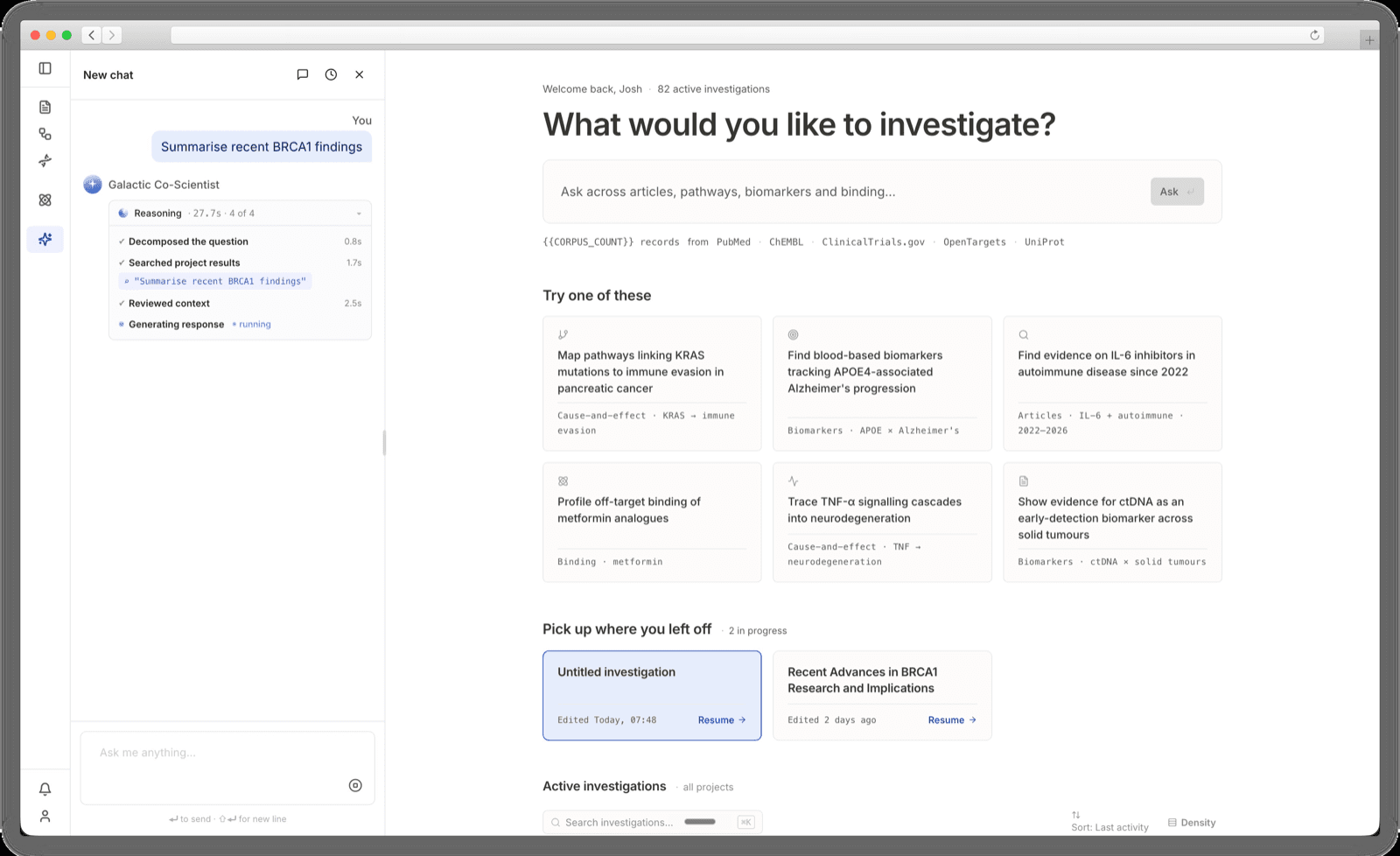
Galactic Co-Scientist is a persistent assistant panel inside Biorelate's web app. You ask a question in plain English; it works out which biomedical concepts you mean, takes you to the right part of the platform, and answers in a few lines where every claim is backed by a linked scientific paper. When the data is not there, it says so rather than inventing something.
I led it as the entire design function. At Biorelate, that is a role of one: I own product design, UX, front-end specification, the design system and brand across every product line. On this feature I authored the product requirements, drove the naming, held the scope against steady pressure to widen it, and designed the trust model below. The decision to build it, and the commercial strategy behind our enterprise pharma accounts, sat with the CSO and CEO; the product and its design were mine to define.
The verification tax
Before this, researchers bounced between our platform, public tools like PubMed, and a general LLM to summarise, then spent longer checking whether the references were even real. The pain was not speed, it was doubt. A scientist at a global animal-health company put it bluntly: with general LLMs, most of the time the references are not real.
The job was not to build a faster answer engine. It was to remove the verification tax, so checking the answer was trivial, not a second job.
Grounded, not generated
The central decision: the assistant retrieves only relationships extracted from real literature at query time, and is forbidden from answering from the model's own training. Every factual statement ends in a linked citation badge to a real paper. The provenance runs all the way down: from the model's sentence, to the relationship in our knowledge graph, to the exact evidence sentence, to the source publication and its DOI. Confidence is shown as evidence, the number of supporting documents, not as a number the model invented about its own certainty. The phrase I kept coming back to: this should be AI with data you can touch.
Most of the interesting work was subtraction. Deciding what the AI must not do mattered more than what it could:
No general knowledge
Every biological statement comes from a returned result, never from training data.
Resolve before acting
Map input to a canonical ontology ID first: models guess IDs, and a wrong ID means a silently wrong answer.
No raw internals
Never show internal IDs; never dump every reasoning step by default.
Refuse over fill
When evidence does not load, say it cannot answer, rather than fill the silence.
None of these are visual decisions, but all of them are design decisions: each is about what the user is allowed to trust.
Decisions I will defend
Where the assistant lives. I chose a persistent side panel available on every page, over three alternatives:
Upgrade the standalone chat
Lived outside the workflow: constant context-switching.
Per-feature contextual chat
Could not navigate across the product; multiplied maintenance.
Dashboard-only home
Reintroduced the same context-switch problem.
Persistent side panel
The only option that let the assistant move the user through the app rather than sit beside it.
Questioning my own project: the decision I am proudest of. I refused to assume that because the thing was agentic it would automatically be better. We tested the grounded approach against a generic model, and on well-known targets the knowledge graph added little: the general model already knew the textbook biology. An uncomfortable result for the premise of the feature. Rather than bury it, I let it move the bet: the real differentiation was surfacing indirect connections and novelty a general model cannot know. Finding my own premise half-wrong in testing changed the product for the better.
What I got wrong
Where it stands
Co-Scientist is in a live beta with one of the world's largest pharmaceutical companies: a six-month evaluation of Biorelate as their AI co-scientist, with a broader launch to follow. I deliberately argued against usage as the measure of success. Success was defined as whether the client's scientific champions trusted it enough to advocate for it internally, the honest thing to measure for a trust product at this stage. The early signal was exactly that: a lead scientist reported that having the assistant sit beside their work had already changed how they moved through the platform.
There is more to build: an entity-disambiguation flow, a lighter answer mode, and a re-architected backend as the feature outgrows the structure we reused to hit the enterprise timeline. That reuse was the right call for the deadline and is now the thing most in need of replacing, the honest tension between shipping to a real customer window and building for the long term.